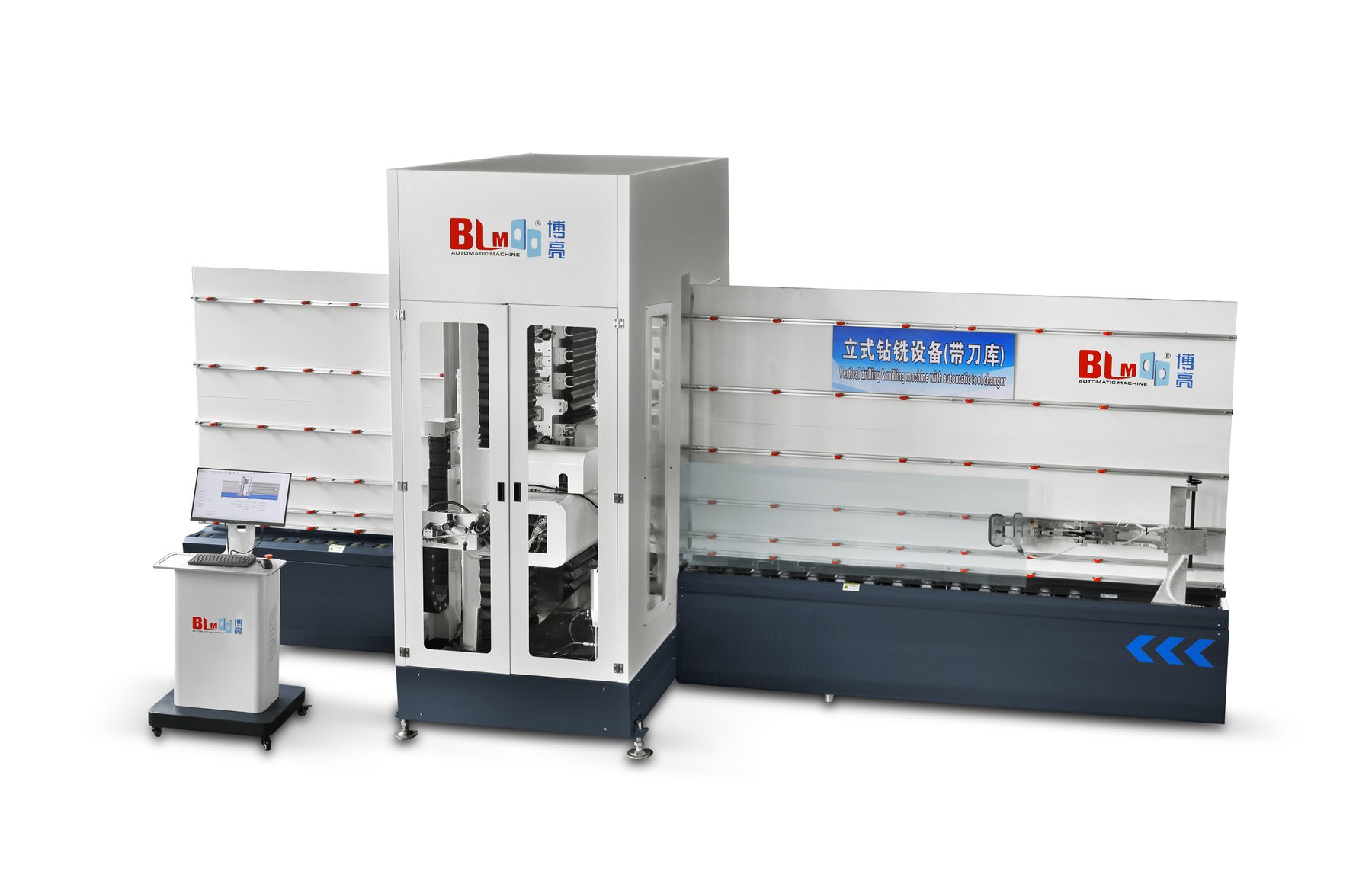
A glass drilling machine makes round holes — hinge bores, dowel holes, towel-bar fixings, typically Φ6–Φ50 mm. A glass milling machine (or the milling function of a CNC centre) shapes the glass: slots, notches, handle cut-outs, shaped corners and edge reliefs that a round drill cannot produce. You need drilling on almost every glass part; you need milling only when your drawing contains a shape that is not a round hole. Many BLM centres do both on one machine — the decision is really "drilling-only" versus "drilling + milling" configuration.
What a glass drilling machine does
Drilling is the core operation on most processed glass parts. On BLM CNC drilling machines the spindle drives a tubular (core) drill with diamond tooling, removing an annulus of material to leave a clean-walled round hole. Across the range, hole diameters run Φ6–Φ50 mm on glass from 4–19 mm thick — hinge holes on shower doors, fixing holes on architectural panels, dowel and handle bores on furniture and appliance glass.
What characterises a drilling-focused machine:
- Speed per hole. A dedicated drilling spindle completes a hole in seconds; a 2+2 spindle machine like the A66 processes two holes simultaneously with automatic positioning.
- Throughput orientation. Drilling machines are laid out for volume: the A66 targets shower door batches at 45–90 s per panel; the A98 runs 8+8 spindles for mixed hole diameters on large panels.
- Round holes only. A core drill cuts a circle. If your drawing contains a shape that is not a circle, a drilling machine alone cannot produce it.
What milling adds
Milling uses a rotating end-mill moving along a programmed path, so it can produce any contour the toolpath describes. On glass, milling is used for:
- Handle cut-outs and finger pulls on shower doors and cabinet glass.
- Notches and reliefs where the glass must clear a hinge body, bracket or wall profile.
- Shaped corners and cut-outs — rounded rectangles, L-shapes, arcs.
- Slot and channel features for gaskets, connectors or fixings.
- Edge work: limited edge trimming and polishing passes with the right tooling.
On BLM machines, milling is not a separate product line — it is a configuration of the CNC drilling centres. The A71X vertical drilling and milling machine carries a tool magazine (BT40 taper) so it can change between drills and milling tools within one program; the A98 pairs 8+8 drilling spindles with a rotary tool magazine for large panels that need both dense hole patterns and shaped features.
Glass drilling machine vs milling machine — side by side
| Aspect | Glass drilling machine | Milling (drilling + milling CNC centre) |
|---|---|---|
| Feature produced | Round holes, Φ6–Φ50 mm | Slots, notches, cut-outs, shaped contours |
| Tool | Diamond core drill, fixed diameter | End-mills, path-controlled |
| Cycle per feature | Seconds per hole | Longer — the tool travels the contour |
| Best suited to | Batch parts defined by hole patterns (shower doors, panels) | Mixed parts with shapes plus holes |
| Machine examples | A66, A31D / A82 / A83 lines, dedicated drilling models | A71X (tool magazine), A98 (8+8 spindles + rotary magazine) |
| Typical buyer | High-volume single-part producers | Fabricators running varied drawings |
Which one does your part need — decide from the drawing
The fastest test is the drawing itself. Sort every feature on it into two lists:
- Round holes → drilling. Count the diameters: if you run more than two or three diameters per part, you want multi-spindle or magazine tooling rather than a single-spindle drill.
- Anything not round → milling. Every notch, slot and shaped cut-out in that list means a drilling-only machine cannot produce the part by itself.
Then weigh the batch profile:
- One repeated part, holes only, high volume → a drilling machine or a drilling line (A66 class; A31D / A82 / A83 for shower lines).
- Varied parts, holes plus shapes → a drilling + milling centre (A71X vertical, or A98 for large-format panels).
- Shapes plus very dense hole patterns on large glass → A98: eight drilling spindles handle the hole load while the rotary tool magazine covers milling.
If you are unsure, send the drawing. BLM sales and engineering confirm which configuration covers your feature list before quoting — and tell you honestly when a simpler, cheaper drilling-only machine is enough.
Common misunderstandings
"Milling replaces drilling." It does not. Milling a round hole by tracing a circle is far slower than drilling it with a core drill. On combined machines, round holes stay on the drilling spindles; milling only handles the contours.
"I need milling because my competitor has it." Configuration follows the part, not the showroom. If your whole catalogue is hinge holes and fixing bores, a drilling machine at half the investment will beat a milling centre on throughput and cost per panel.
"Holes and cut-outs can be done after tempering." They cannot. Drilling and milling are both done before toughening — tempered glass shatters if machined. Plan the processing sequence upstream of the tempering furnace.
"A magazine makes the machine complicated to run." Tool changes inside a program are automatic. The operator loads a part and calls the program; the control handles drill-to-mill transitions. DXF import (optional on BLM CNC centres) removes manual programming for shaped contours.
Send your part drawing for a configuration check
Send one representative drawing with the feature list marked. We will confirm which features need milling, which machine covers them, and quote standard and optional equipment separately.
Request a Project QuoteWhatsApp insteadFAQ
Can a milling machine make holes instead of a drilling machine?
Technically a contouring end-mill can trace a circle, but it is much slower than a core drill and wears tooling unnecessarily. On every BLM drilling + milling centre, round holes are produced by the drilling spindles; milling is reserved for shapes.
Do I need a drilling and milling machine for shower doors?
Only if your door drawings include non-round features — handle cut-outs, hinge-body notches or shaped corners. If your doors are defined by hinge and handle-bores only, a drilling machine such as the A66 produces them faster at lower investment.
What is the difference between the A71X and A98 for milling work?
The A71X is a vertical machine with a BT40 tool magazine in four size variants (2515 / 3020 / 4225 / 6030), suited to mixed parts with shapes and holes up to 6000 × 3000 mm. The A98 is a horizontal 8+8 spindle centre with a rotary tool magazine for large architectural panels with dense hole patterns plus milling features.
Is glass drilled before or after tempering?
Always before. Drilling and milling must be completed on the glass before toughening; machining tempered glass causes it to break. Sequence your flow so processing happens upstream of the tempering furnace.
Draft figures marked “Pending spec confirmation” come from BLM product documents and are replaced by a signed specification sheet before publication. BLM does not publish unrecorded performance or pricing data.